

Could your Florida property taxes be changing? Here's what Amendment 3 means for homeowners in Sarasota, Bradenton, Lakewood Ranch, and beyond.
If you've owned a home in Florida for any length of time, you already know there are a few things we love to talk about: the weather, the traffic, how much Florida has grown, and, of course….property taxes.
And lately? That last one has been getting quite a bit of attention.
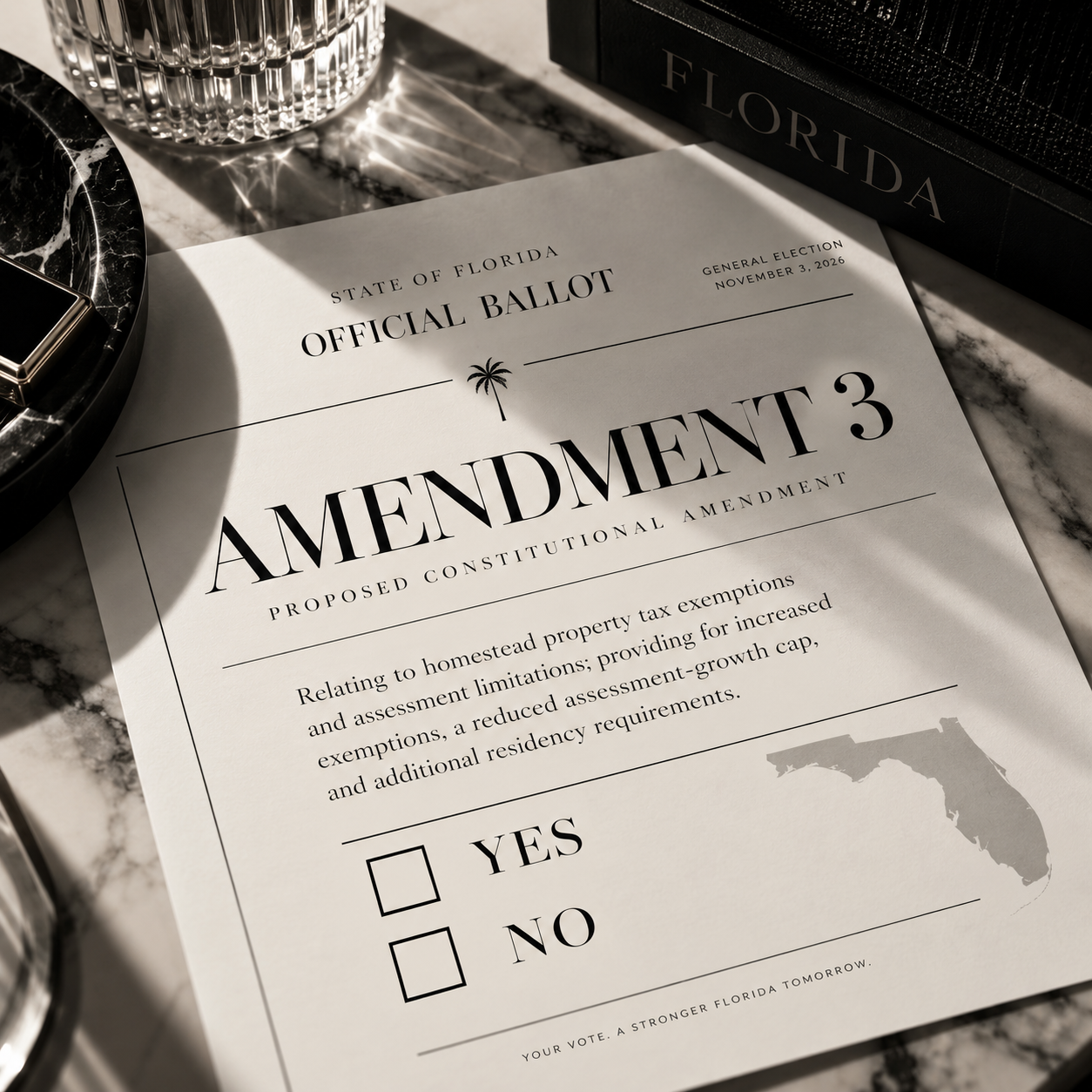
Florida Amendment 3 is on the November 3, 2026 ballot, and depending on the outcome, it could change the way property taxes are calculated for homeowners throughout Sarasota, Manatee County, and the rest of Florida.
We're talking potentially larger homestead exemptions, changes for investment properties, and some important details for anyone thinking about relocating to Florida.
Sounds pretty good, right?
Well, as with most things involving real estate and taxes, there's a little more to the story.
So let's get into it.
What is Florida Amendment 3 in 2026?
Florida Amendment 3 is a proposed constitutional amendment that would increase the homestead exemption for non-school property taxes to $150,000 in 2027 and $250,000 in 2028 for qualifying homeowners. It would also reduce the annual assessment-growth cap for most non-homestead properties from 10% to 5% and establish additional eligibility requirements for new Florida residents.
The amendment needs at least 60% voter approval on November 3, 2026, to become law.
Here's the proposed timeline:
| 2026 | Current exemption structure remains |
| 2027 | Up to $150,000 for non-school property taxes |
| 2028 | Up to $250,000 for non-school property taxes |
| 2029 & Beyond | Annual inflation adjustments
That's a pretty substantial difference. But before you start mentally spending those tax savings on a kitchen renovation or a long weekend somewhere fabulous, there's something important to understand.
This isn't a $250,000 check from the state.
It's a reduction in the assessed value of your home that's subject to certain property taxes.
And that distinction matters.
How much could Florida homeowners save under Amendment 3?
Let's put some numbers behind it.
Say you own a home in Sarasota with an assessed value of $400,000.
For this example, we'll assume you're eligible for the full proposed exemption and your non-school property tax rate is 10 mills, or $10 for every $1,000 of taxable value.
Under a simplified $50,000 exemption baseline, you'd pay applicable non-school property taxes on $350,000 of assessed value.
Under the proposed $250,000 exemption in 2028, that taxable value could drop to $150,000.
The hypothetical difference? Approximately $2,000 per year.
Not exactly pocket change.
Of course, your actual savings would depend on your home's assessed value, existing exemptions, local millage rates, and other factors. The current exemption is also partially adjusted for inflation, so this example is intentionally simplified.
And here's the fine print: school district property taxes would still apply.
So while Amendment 3 could lower certain property taxes, it wouldn't automatically eliminate your entire bill.
How would Amendment 3 affect existing Florida homeowners?
Already own a home in Sarasota or Manatee County? This is where things get interesting.
If you've lived in Florida for a while, there's a good chance you've heard of something called Save Our Homes.
And if you haven't, you should.
Florida's Save Our Homes provision generally limits annual increases in the assessed value of qualifying homesteaded property to 3% or the change in the Consumer Price Index, whichever is lower.
It's one of the reasons your neighbor, who purchased their home fifteen years ago, might have a significantly different property tax bill than someone who bought a similar home last year.
Amendment 3 would not eliminate Save Our Homes or Florida's existing portability benefits.
Instead, qualifying homeowners could potentially benefit from the existing assessment limitation and the proposed larger homestead exemption.
For longtime Florida homeowners, that's worth paying attention to.
Ashley Fawn Sanders | broker-owner